The Fate of the Fourteenth British Colony
November 19, 2026By Peter Hill
“Cut is the branch that might have grown full and straight,” – Christopher Marlowe
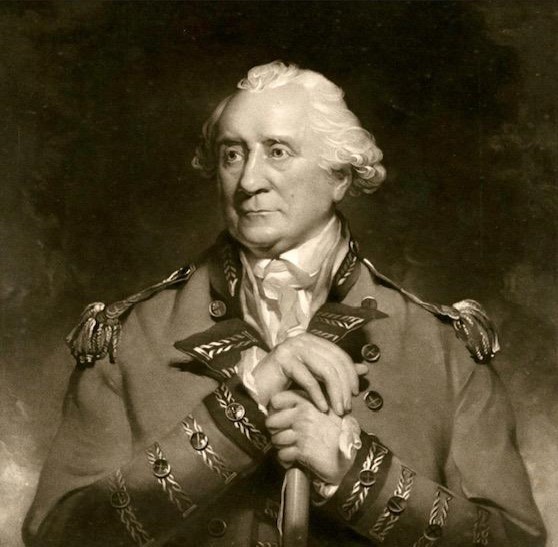
General Patrick Tonyn 1725-1804, British Governor of East Florida 1774-1785, Courtesy of Wikipedia Commons.
East and West Florida had been British Colonies for only twenty years before they were returned to Spain in the peace Treaty of Paris in 1783 that more importantly recognized the formation of thirteen former royal British colonies into the new republic of the United States of America. British West Florida had already been effectively lost when Spanish forces lead by Bernado Galves, for whom Galveston, Texas is named, captured its capital, Pensacola, in 1781.
Valiant East Florida, however, had turned back repeated Patriot invasion attempts from 1776 through 1778. Loyalist forces based in Florida like the Royal American Regiment (first organized during the French and Indian War when the British and Americans were allies) even went on the offensive marching up Florida’s Kings Road from St. Augustine into Georgia. They joined other British Forces already there to occupy Savannah and briefly reconquer Georgia for King George III! Believing they would be as safe as the Loyalists fleeing north to Canada, many refugees arrived in Florida after the British surrender at Yorktown in 1781.
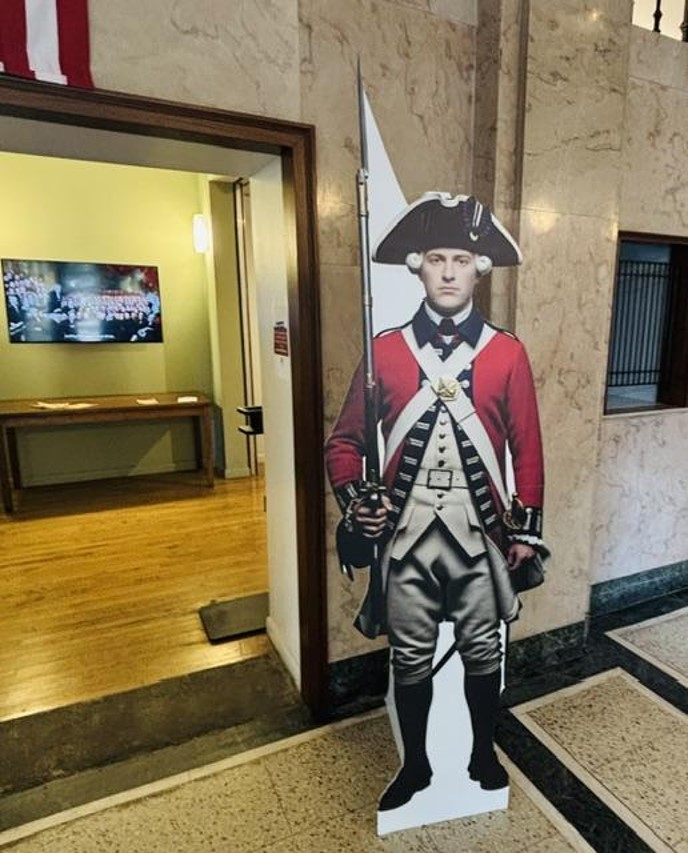
Cutout of a British Redcoat at the Governor’s Mansion in Saint Augustine, Florida. Photo by Peter Hill
The central figure in this drama was the British Governor, General Patrick Tonyn. Tonyn arrived in East Florida in 1774 just as rebellion began to sweep the northern British colonies. However, the Florida colonies were still economically dependent on Great Britian. They were populated with loyal army veterans of the French and Indian War and land hungry planters from the Caribbean. Given their dependency on Britain, the Florida colonies refused invitations to attend the Continental Congress of 1774 in Philadelphia that would produce the Declaration of Independence two years later.
Immigration into Florida was facilitated by a British settlement policy of family right. The head of a family was granted 100 acres of land plus 50 additional acres for each additional family member either White or Black. While some Blacks had obtained freedom under Spanish rule, most were enslaved Africans who worked in the indigo fields and timber harvesting that fueled East Florida’s prosperity. Under this land policy, Florida’s population had rebounded from the few hundred souls at the end of the first Spanish period to several thousand. Tonyn quickly established good relations with the central and western Florida Indian tribes meeting with their chiefs, Cowcatcher and Long Warrior, and established military alliances with them.
Those treaties meant Patriot invaders of Florida always crossed the St. Mary’s River with trepidation knowing they would likely face not only British regular soldiers, but also the fierce warriors of the forests and swamps who would not just kill them, but delight in taking their scalps. As more Loyalists arrived in St. Augustine, Tonyn had Major General Augustine Prevost, known as Old Bullet Head to his troops, organize the men into several infantry regiments. The third component of Florida’s defense force, and one that Tonyn would come to regret having supported, were irregular units like the East Florida Rangers lead by Thomas, Burnt Foot, Brown. Brown had acquired his injury through torture by Georgia Patriots because he refused to renounce his loyalty to Britain. Escaping to Florida, Brown understandably harbored an implacable hatred for American Patriots. Saint Augustine became the epicenter of British resistance in the American South. When news reached there in July of 1776 that the Continental Congress had declared independence, effigies of John Hancock and Samual Adams were burned in the central plaza. St. Augustine would eventually hold three signers of the declaration, Thomas Hayward, Jr., Arthur Middleton and Edward Rutledge as prisoners of war.
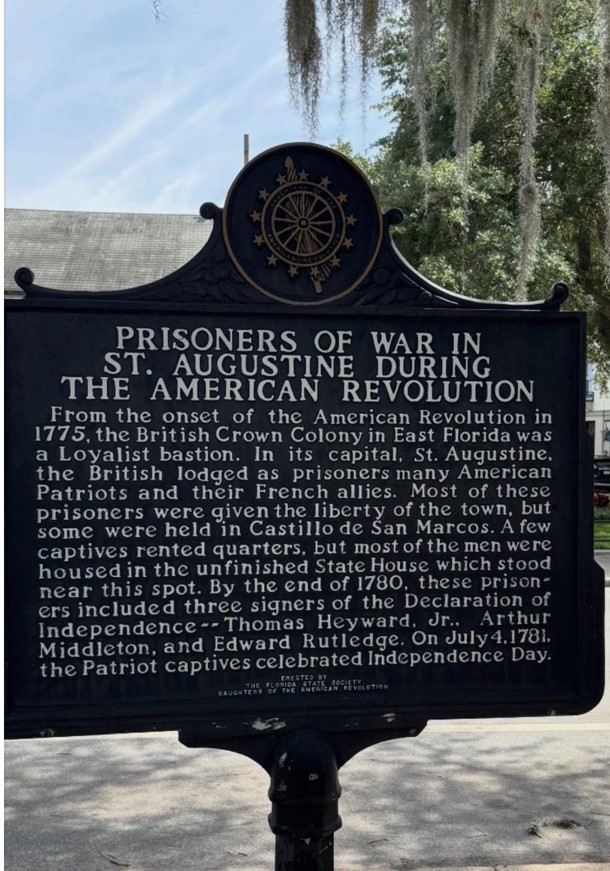
Historical Marker in St. Augustine Florida, Photo by Peter Hill.
The thriving colony grew to 13,000 people. Becoming rather cosmopolitan, St. Augustine featured a Royalist newspaper, The East-Florida Gazette, and even had a theater! One production there, The Beau Stratagem, discussed the ageless challenge of men endeavoring to marry women above their station for their money. Because East Florida had defeated repeated Patriot invasions, the American Commander in the South, General Nathaniel Green, advised George Washington that, despite the American victory at Yorktown, further attempts would still likely be just as futile. The British felt safe in their East Florida enclave, therefore, it came as quite a shock when news reached St. Augustine that both West and East Florida had been returned to Catholic Spain in the Treaty of Paris! British who would not convert to Catholicism or at least agree not to openly practice their Protestant rites, had 18 months to sell their property and leave!
Great Britain of that age was a society that believed in the law. Unlike France or Spain where their Catholic monarchs’ wishes were absolute, Britons looked at laws created by Parliament as a check on royal power and prerogatives. Parliament’s power over the monarchy had been established in the Glorious Revolution of 1688 when it invited a Protestant, William of Orange from Holland, to replace their anointed King, James II whom they adjudged to be too Catholic in outlook.
Not surprisingly, the soon to be disenfranchised Floridians appealed to Parliament not to be put under Spanish Catholic authority. They specifically argued the Magna Charta of 1215 denied any king the power to give away their land! Not too surprisingly, Parliament exhausted by the costs of the American war, disregarded their pleas. Meanwhile, Florida slowly descended into chaos. The irregular militias, particularly those men following the infamous McGirt brothers who as East Florida Rangers had previously raided Patriot plantations in Georgia, now turned their lawlessness on the Florida plantations between St. Augustine and the Saint Mary’s River. Rape, murder, arson and the theft of indigo and slaves were their stock in trade.
Spain compounded the crisis by not arriving on time with new troops to reestablish law and order as British regular forces were withdrawn. Lawless in another way, British merchants continued to harvest, untaxed, the live oaks of the St Mary’s River needed by the Royal Navy. The Spanish governor, Vincente Manual Zespedes y Valasco, eventually arrived in St. Augustine in June of 1784. This displaced Tonyn from the Governor’s mansion, and Tonyn eventually relocated to a ship anchored in the Amelia River where he supervised the evacuation. Tonyn had largely reestablished law and order by creating mounted units that kept the McGirts and those of their ilk in check. He then turned his attention to how to evacuate the thousands of British loyalists. The harbor of Saint Augustine would not be suitable for the task. It’s shifting sand bars and lack of draft for the large transport ships necessary had resulted in the drowning deaths of hundreds of loyalists just trying to get to St. Augustine.
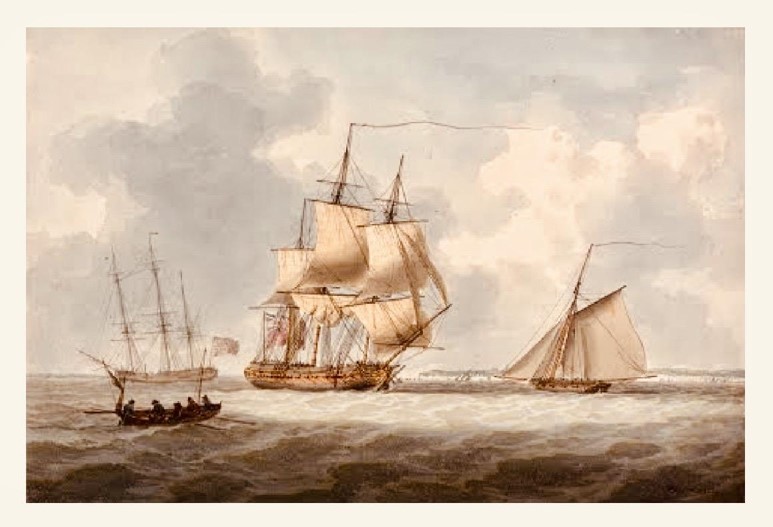
A (British) Frigate Awaiting a Pilot, William Anderson 1757-1847.
With every other reachable port north of the Saint Mary’s now in the hands of the United States and thus unavailable, Tonyn instead determined the evacuation would take place from the deep roadstead that lay to the west of the bluffs on the north end of Amelia Island. A map drawn by British Captain William Fuller in 1769 shows the traditional grid pattern of a New Town there, and a Causeway thro the Marsh up to the Bluffs within 15 Yards of which Ships of 300 Tons can lie and deliver their Goods.
Perhaps such a grand new town as illustrated on the map was just wishful thinking, but temporary quarters were indeed necessary for the thousands of evacuees. Richer Planters attempted to transport their extended families, slaves and building materials necessary to build again once they arrived at their next destination. With limited space available, many were forced to sell almost everything, often at a steep discount as there were few new Spanish settlers to bid for their goods. An estimated three thousand others decided to try their luck on the frontiers of the new American republic, crossed into Georgia and disappeared to history.
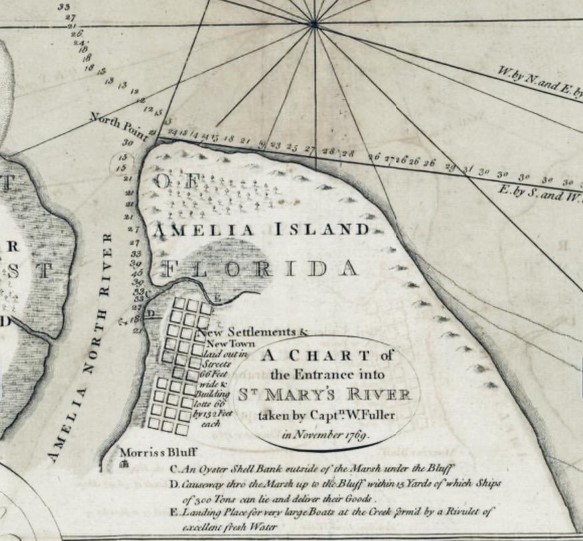
Fuller’s Map of Florida Courtesy of the Library of Congress.
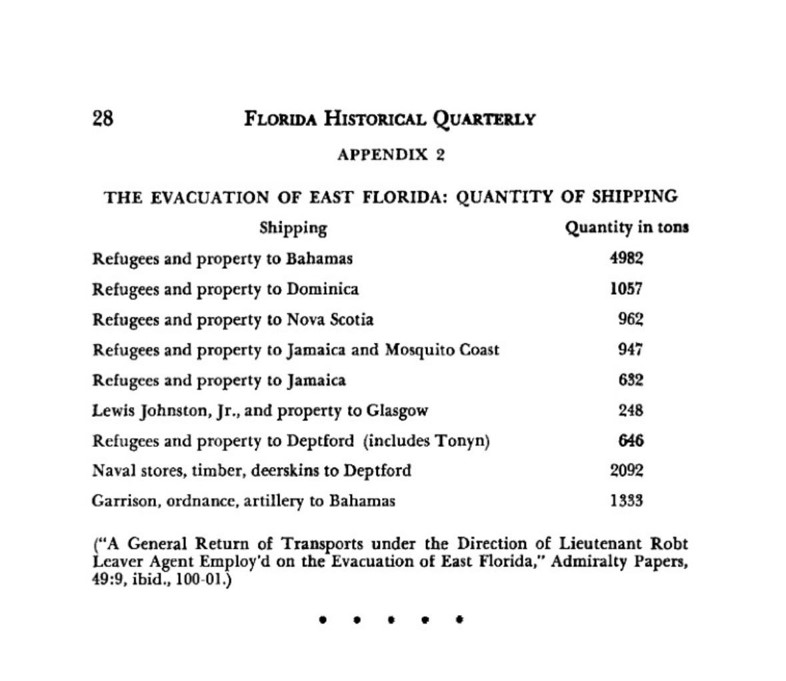
Tonyn spent a considerable amount of the King’s treasury to transport these second time refugees first to Amelia Island, and then to the remaining British colonies in the Western Hemisphere, Scotland and England. On the 19th of November of 1785, over ten years after the shot heard round the world at Lexington and Concord, four years after the British surrender at Yorktown, two years after the Treaty of Paris, and nearly a year and a half after the Spanish nominally resumed administration of Florida, Patrick Tonyn descended the bluffs of Amelia Island and boarded the Two Sisters bound for Deptford, England. Just an estimated 200 Whites and 400 Blacks remained in East Florida. After twenty prosperous, tumultuous years, the brave British colony of East Florida ceased to exist. Tonyn, unliked by all, but nevertheless a loyal and capable servant of his king, lived on in London until his death in 1804.
Tonyn spent a considerable amount of the King’s treasury to transport these second time refugees first to Amelia Island, and then to the remaining British colonies in the Western Hemisphere, Scotland and England. On the 19th of November of 1785, over ten years after the shot heard round the world at Lexington and Concord, four years after the British surrender at Yorktown, two years after the Treaty of Paris, and nearly a year and a half after the Spanish nominally resumed administration of Florida, Patrick Tonyn descended the bluffs of Amelia Island and boarded the Two Sisters bound for Deptford, England. Just an estimated 200 Whites and 400 Blacks remained in East Florida. After twenty prosperous, tumultuous years, the brave British colony of East Florida ceased to exist. Tonyn, unliked by all, but nevertheless a loyal and capable servant of his king, lived on in London until his death in 1804.